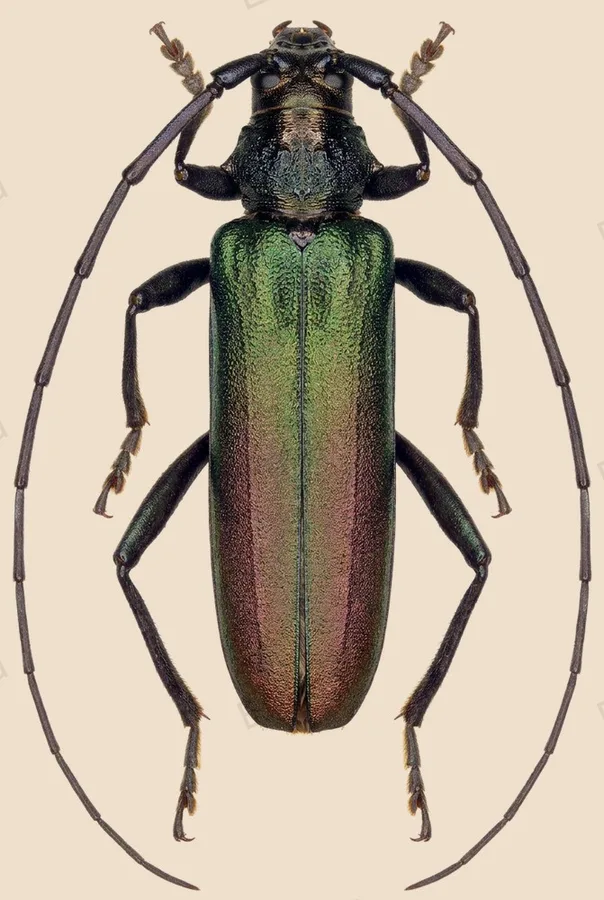
Musk beetle
When threatened, this beetle releases a musky secretion containing rose oxide, a compound also prized as one of perfumery's most valued fragrances.
| Where | Willows and other waterside trees |
|---|---|
| Size | 20 to 40 mm body length |
| When | June to August |
The musk beetle is a large, elongated longhorn with a metallic green to bluish-black body and a coppery sheen, and antennae that often exceed its own body length.
Adults are active in summer, often found on willow and other waterside trees, and release a musky-smelling defensive secretion from glands near the hind legs when handled.
Traits
Habitat
Wetland
Colour
Green, Metallic
Active
Day
To people
Harmless to handle; releases a strong musky smell rather than biting when disturbed.
Activity through the year
Often confused with
Smaller at 25 to 35 mm, with shiny black elytra and a reddish pronotum, though some musk beetle forms also show a red pronotum, so overall size and leg length help confirm identity.
Questions
Is the Musk beetle dangerous to people?
Harmless to handle; releases a strong musky smell rather than biting when disturbed.
When can you see the Musk beetle?
The Musk beetle can be seen from June to August, by day.
Sources inaturalist.orgwildlifetrusts.orgen.wikipedia.org
Plate retouched from a photo by Gubin Olexander, CC BY‑SA 4.0, Wikimedia Commons Licence
The plate on this page is shared under the same licence as its source, CC BY-SA.
Report a mistake in this entry
Beetles›Longhorn beetles›Aromia
Last updated 2026-10-17. Every entry is checked against published sources.