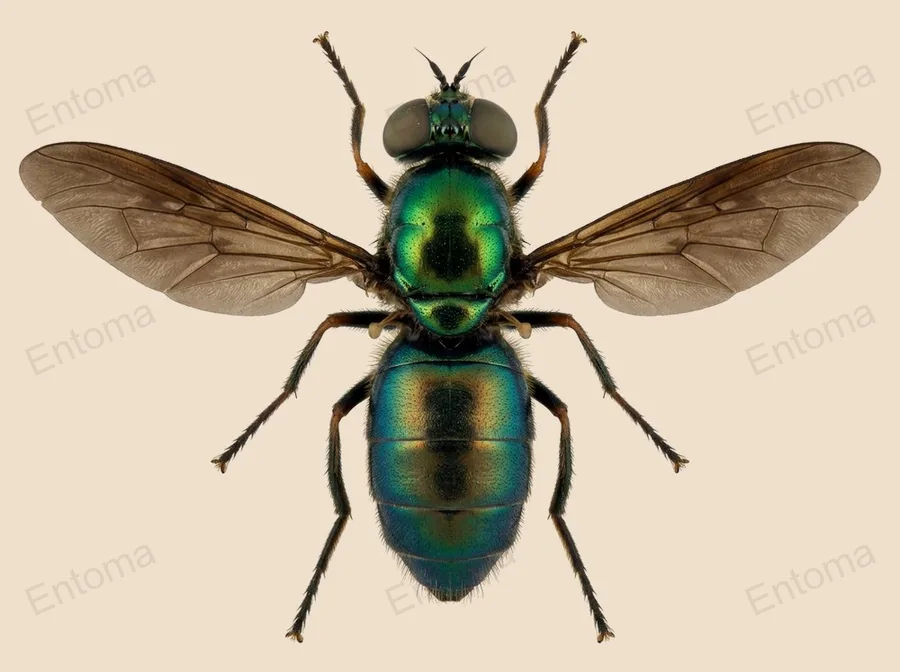
Broad centurion fly
Males and females look almost like different species: males have a coppery gold abdomen and touching eyes, females a blue-green abdomen with separate eyes.
| Where | Grassland, hedgerows, garden margins |
|---|---|
| Size | 7 to 9 mm long |
| When | May to August |
This small soldier fly has a metallic green thorax and a shiny abdomen that looks blue-green with a purple sheen in females and coppery gold in males.
Its densely hair-covered eyes, which meet at the top of the head in males, separate it from the similar Sargus soldier flies it is often mistaken for.
The Broad centurion fly is up to 9 mm long and lives in wooded areas, hedgerows, parks and gardens. Adults are mostly seen from May to August, feeding on flower nectar, mainly from the carrot family. The larvae feed on decaying plant matter in the soil and among dead leaves.
Traits
Habitat
Grassland
Colour
Metallic, Green, Blue
Active
Day
To people
Harmless
Activity through the year
Often confused with
Sargus soldier flies lack Chloromyia's densely hairy eyes, which in male broad centurions meet in a solid patch at the top of the head.
Questions
Is the Broad centurion fly dangerous to people?
The Broad centurion fly is harmless to people.
When can you see the Broad centurion fly?
The Broad centurion fly can be seen from May to August, by day.
Sources naturespot.orgwildlifetrusts.orgen.wikipedia.orgnaturespot.org.uk
Plate retouched from a photo by S. Rae from Scotland, UK, CC BY 2.0, Wikimedia Commons Licence
Report a mistake in this entry
Flies›Soldier flies›Chloromyia
Last updated 2026-10-17. Every entry is checked against published sources.