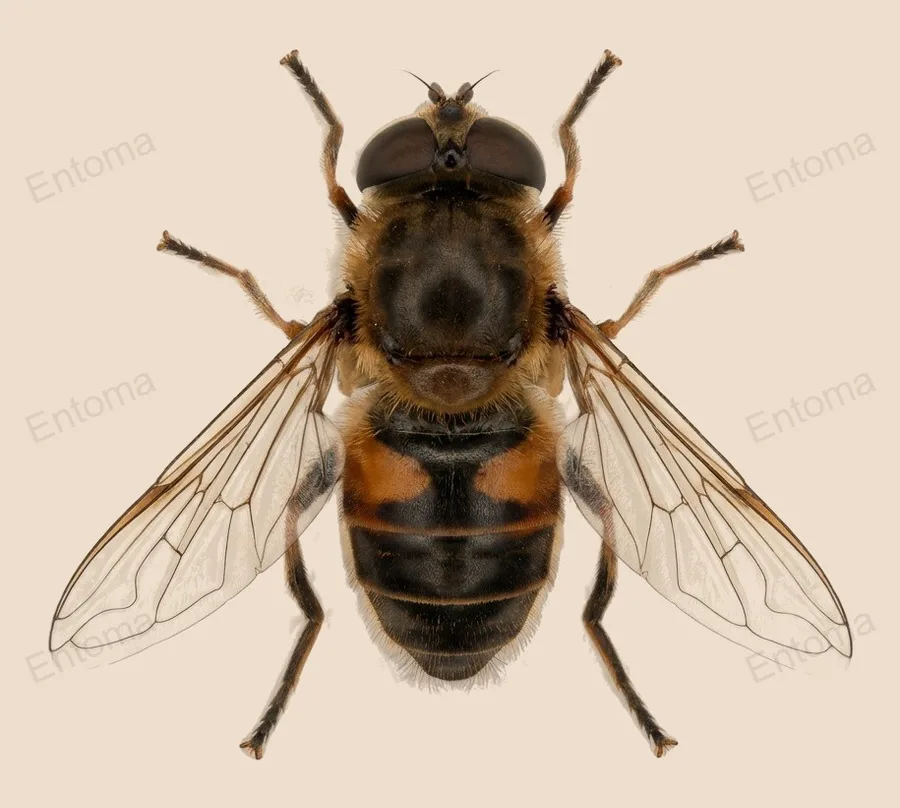
Common drone fly
Its larva is the rat-tailed maggot, which breathes through a long telescopic tube while living in polluted water.
| Where | Gardens, farmland, flowers near ponds and ditches |
|---|---|
| Size | 12 to 15 mm |
| When | March to December |
The adult mimics a male honey bee so closely that for centuries people believed bees could be born from dead animals.
It is one of the last insects on autumn ivy flowers, and females spend the winter in buildings and crevices.
The adult has a dark brown body with orange patches on the sides of the abdomen. It looks like a honey bee but has no narrow waist and only one pair of wings, since it is a fly rather than a bee. It is a very common hoverfly found across much of the world.
Traits
Habitat
Garden
Colour
Brown, Yellow
Active
Day
To people
Harmless; cannot sting
Activity through the year
Often confused with
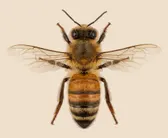
The honey bee has two pairs of wings, elbowed antennae and smaller eyes.
Read more in the guides
Hoverflies that look like bees and waspsQuestions
Is the Common drone fly dangerous to people?
Harmless; cannot sting.
When can you see the Common drone fly?
The Common drone fly can be seen from March to December, by day.
Sources en.wikipedia.orgnaturespot.orgiucn-uk-peatlandprogramme.org
Plate retouched from a museum specimen photo by Natural History Museum, CC0, GBIF Licence
Report a mistake in this entry
Last updated 2026-10-17. Every entry is checked against published sources.