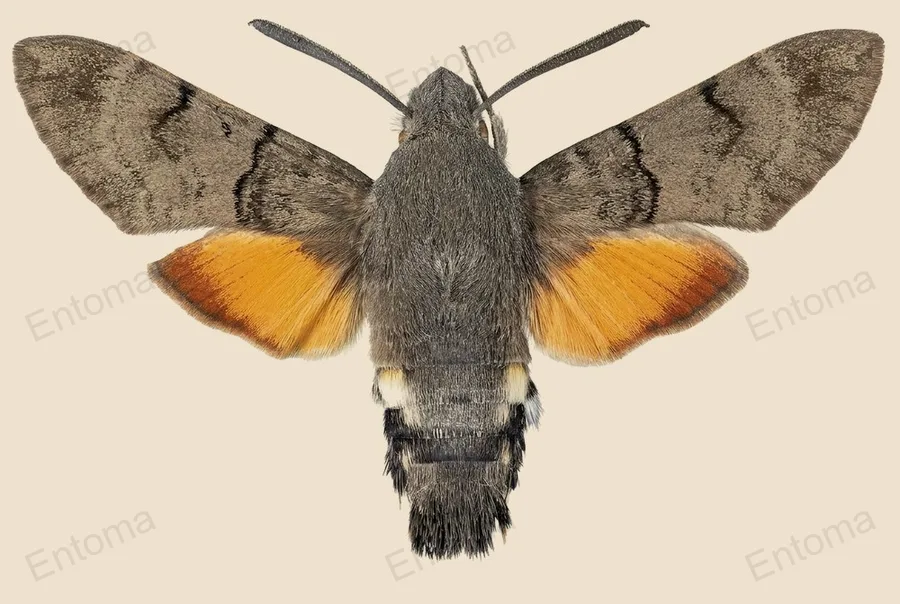
Eurasian hummingbird hawkmoth
It hovers at flowers and beats its wings around 80 times a second, fast enough that many people mistake it for a real hummingbird.
| Where | Gardens, parks and flowery grassland |
|---|---|
| Size | 50 to 58 mm wingspan |
| When | May to October |
Grey-brown forewings contrast with bright orange hindwings that show only in flight, and the fanned, checkered tail resembles a small bird's tail.
It is a strong migrant from southern Europe and North Africa, and in some years breeds far enough north to be seen across much of northern Europe.
The caterpillars feed on bedstraws, and the pupa lies in a loose cocoon among leaf litter or plant debris. Adults spend the winter in crevices in walls, trees and outbuildings, so a few can be seen in any month of the year.
Traits
Habitat
Garden
Colour
Brown, Orange
Active
Day
To people
Harmless
Activity through the year
Often confused with
Bee hawkmoths have mostly clear, scale-free wings, while the hummingbird hawkmoth's wings are solidly coloured grey-brown and orange.
Read more in the guides
The moth people mistake for a hummingbirdQuestions
Is the Eurasian hummingbird hawkmoth dangerous to people?
The Eurasian hummingbird hawkmoth is harmless to people.
When can you see the Eurasian hummingbird hawkmoth?
The Eurasian hummingbird hawkmoth can be seen from May to October, by day.
Sources en.wikipedia.orgfirst-nature.combutterfly-conservation.org
Plate retouched from a photo by Didier Descouens, CC BY‑SA 4.0, Wikimedia Commons Licence
The plate on this page is shared under the same licence as its source, CC BY-SA.
Report a mistake in this entry
Butterflies and moths›Hawk moths›Macroglossum
Last updated 2026-10-17. Every entry is checked against published sources.