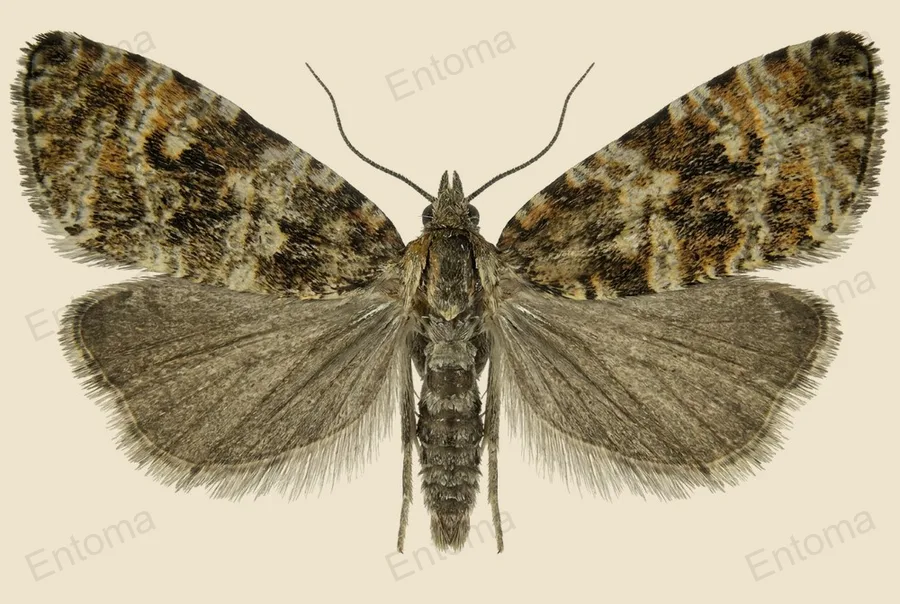
Common marble
It feeds on such a wide range of unrelated plant families that its caterpillars can be found on everything from clover to willow in the same season.
| Where | Hedgerows, verges, and grassy fields |
|---|---|
| Size | 16 to 18 mm wingspan |
| When | May to September |
It is a small, variably patterned moth best told from its relatives by a sharp inward notch in the pale central band above the middle of the forewing.
Caterpillars use an unusually broad range of low plants and shrubs, and the moth flies over a long season, often disturbed by day from hedges and grassy field edges before coming to light after dark.
The Common marble is very common, and its caterpillars have been recorded on an unusually wide mix of plants, among them wild carrot, mint, nettle, bramble, strawberry, willow, birch, larch and spruce. A caterpillar can reach about 15 mm long. The adults normally fly at dusk and in the evening.
Traits
Habitat
Grassland
Colour
Brown, Grey
Active
Day and night
To people
Harmless
Activity through the year
Often confused with
Doubleday's marble lacks the sharp notch cut into the pale central band that identifies the common marble, showing a smoother, more evenly curved band instead.
Questions
Is the Common marble dangerous to people?
The Common marble is harmless to people.
When can you see the Common marble?
The Common marble can be seen from May to September, by day and at night.
Sources ukmoths.org.uken.wikipedia.orgmail.ukmoths.org.uk
Plate retouched from a museum specimen photo by Esko Viitanen, Finnish Biodiversity Information Facility, CC BY 4.0, GBIF Licence
Report a mistake in this entry
Butterflies and moths›Tortrix moths›Syricoris
Last updated 2026-10-17. Every entry is checked against published sources.