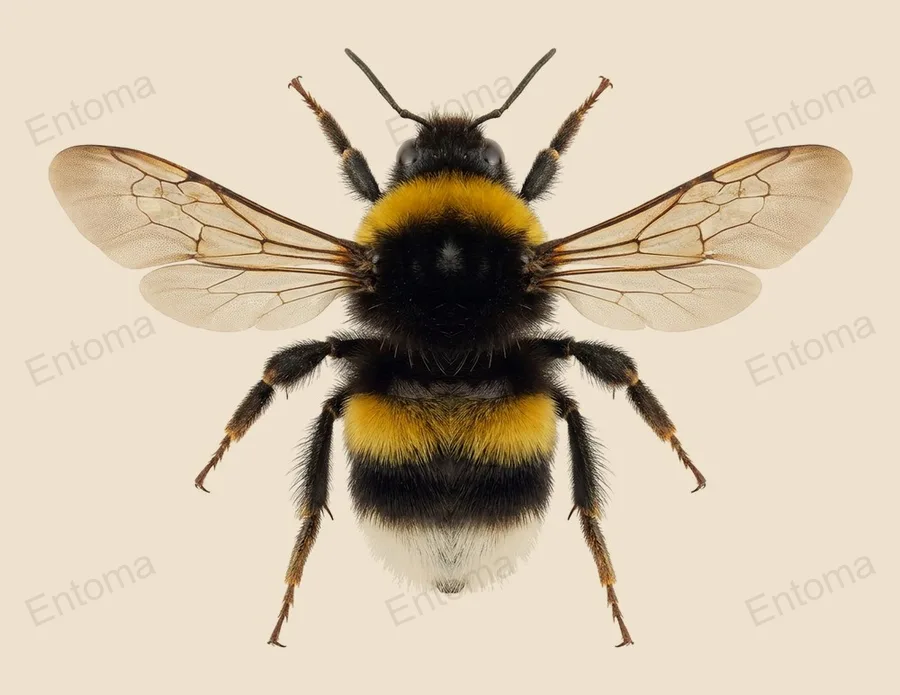
Garden bumble bee
Its tongue can stretch to about 20 millimetres, the longest of any European bumblebee, letting it reach nectar hidden deep inside foxgloves and clover.
| Where | Gardens, hedgerows, grassland |
|---|---|
| Size | 11 to 20 mm long |
| When | March to October |
It is black with two yellow bands on the thorax, a yellow band near the base of the abdomen, and a white tail, with a longer face than most bumblebees.
Its unusually long tongue lets it feed from deep tubular flowers such as foxglove and red clover that shorter-tongued bumblebees cannot reach.
A queen emerges from hibernation in spring and starts a nest on her own, and the first workers appear after about six weeks. Colonies stay small compared with those of many other bumblebees. Males are produced late in the season, towards the end of the summer.
Traits
Habitat
Garden
Colour
Black, Yellow, White
Active
Day
To people
Mild
Females can sting if seriously threatened but rarely do; not aggressive toward people.
Activity through the year
Often confused with
The large garden bumblebee is nearly identical but has an evenly short-haired, velvety-looking thorax with two equally wide yellow bands, while the garden bumblebee's band nearer the wings is narrower than its collar band.
Questions
Is the Garden bumble bee dangerous to people?
Mild. Females can sting if seriously threatened but rarely do; not aggressive toward people.
When can you see the Garden bumble bee?
The Garden bumble bee can be seen from March to October, by day.
Sources en.wikipedia.orgbumblebee.orgbwars.combumblebeeconservation.org
Plate retouched from a photo by Arnstein Staverløkk/Norsk institutt for naturforskning, CC BY 3.0, Wikimedia Commons Licence
Report a mistake in this entry
Bees, wasps and ants›Bees and bumblebees›Bombus
Last updated 2026-10-17. Every entry is checked against published sources.